 Kikelomo Salman
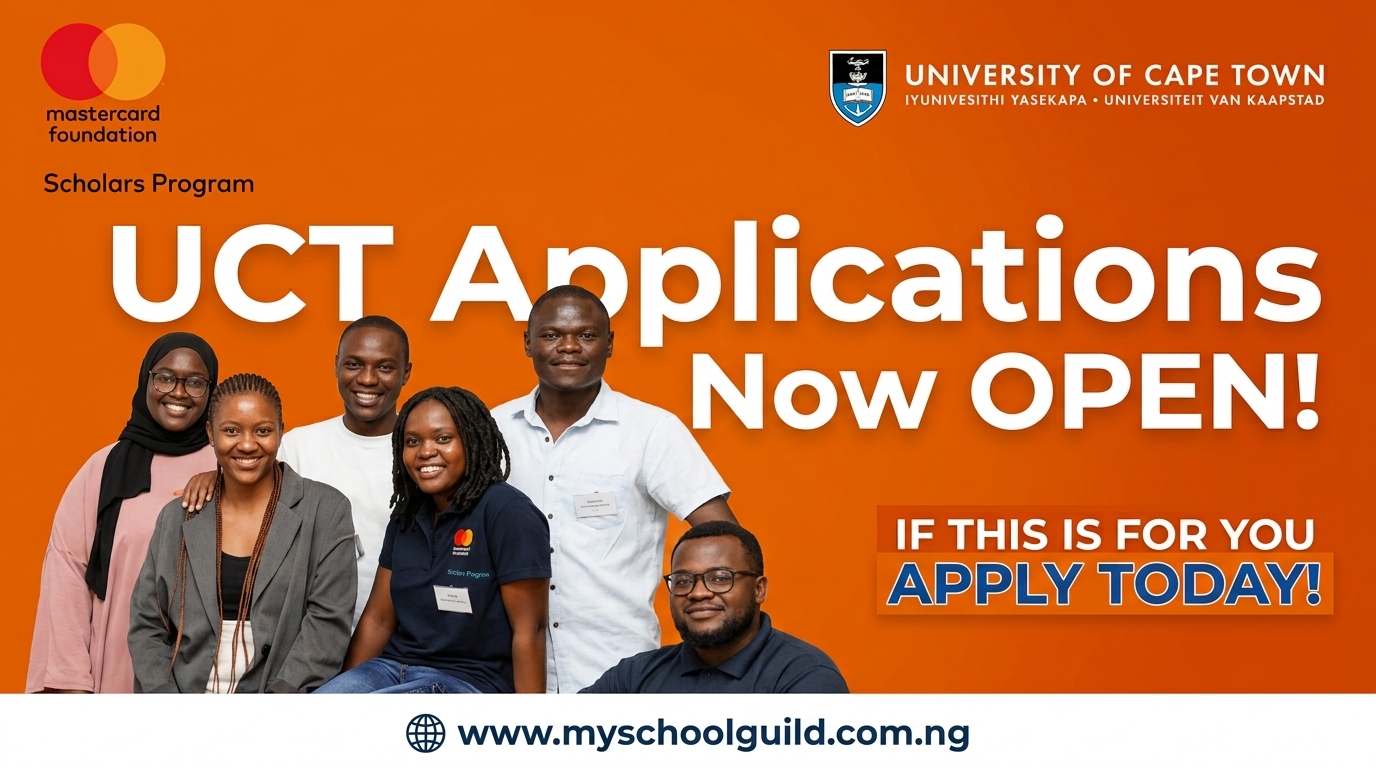
If you’re researching the Mastercard Foundation Scholarship at University of Cape Town, one thing stands out compared to other partner universities. UCT runs two separate deadlines depending on your level of study, and one of them has already passed for this cycle.
This guide covers how UCT’s application process actually works, who qualifies, which fields of study and named programs are eligible, and what’s still open right now.
What Is the Mastercard Foundation Scholarship at University of Cape Town?
The Mastercard Foundation Scholars Program at the University of Cape Town funds academically talented young Africans who face real social and economic barriers to higher education. UCT frames it as more than a scholarship, and the support backs that up. Coverage includes tuition, a laptop, accommodation on UCT campuses, living expenses, medical cover, a study visa where needed, and annual travel between the scholar’s home country and Cape Town.
The scholarship is available for a first bachelor’s degree, or for an eligible postgraduate diploma, honours degree, or coursework master’s degree. It’s worth being clear about what it doesn’t cover too. Part time study isn’t eligible, and neither is a master’s by dissertation only or a PhD. If your plan involves pure research study rather than coursework, this particular scholarship won’t fund it.
The UCT Application Process, Step by Step
UCT’s process is simpler than Edinburgh’s or UBC’s on paper, but it hides an important detail. Applying to the Mastercard Foundation Scholars Program and applying to UCT itself are two completely separate steps, and you need both.
Step 1: Research your study options. Check UCT’s site for the faculty and programme you want before you apply to anything.
Step 2: Apply to UCT directly. This goes through UCT’s own online application portal, separate from the scholarship application. Only applicants who receive an offer of admission from UCT can be considered for the scholarship, so this step comes first in practice even though the scholarship application can run alongside it.
Step 3: Submit your Mastercard Foundation Scholars Program application. This is a distinct form on UCT’s scholarship site, not a checkbox inside your academic application.
Step 4: Wait for your academic offer and scholarship outcome. Because scholarship selection is tied to academic admission, you can’t be confirmed as a scholar until UCT has actually admitted you to your programme.
The detail that catches people out is treating this as one application. It isn’t. Submitting a strong Mastercard Foundation form means nothing if your UCT academic application never gets an offer, and vice versa.
Mastercard Foundation Scholarship Deadlines at UCT for 2027
This is where UCT differs sharply from Edinburgh and UBC. Instead of one deadline, there are two, tied to your level of study.
Undergraduate applicants: the Mastercard Foundation Scholars Program deadline is 30 September 2026, and UCT’s undergraduate academic applications for this intake are already closed. If you’re aiming for a first bachelor’s degree in 2027, this cycle has passed. Your realistic option now is preparing early for the next intake.
Postgraduate applicants: the deadline is 31 October 2026, and applications are still open right now. This covers an eligible postgraduate diploma in the Faculty of Health Sciences, an honours degree, or a coursework master’s programme across any of UCT’s six faculties.
If you’re a prospective postgraduate applicant, this is genuinely still live. Don’t assume the whole cycle is closed just because the undergraduate window shut.
Mastercard Foundation Scholarship Eligibility Requirements at UCT
Core eligibility requirements include:
- Citizenship of an African country, including South Africa itself
- Applying for a first bachelor’s degree, or an eligible postgraduate diploma, honours degree, or coursework master’s programme at UCT
- Demonstrated academic talent and a genuine commitment to completing your education
- Significant social and economic barriers limiting your access to higher education
- Potential for transformative and ethical leadership
- A clear commitment to serving your community and contributing to positive change after graduating
UCT is explicit that it particularly welcomes applications from young women, people living with disabilities, refugees, and forcibly displaced youth, along with anyone whose access to education has been limited by social or economic circumstances. As with similar programs elsewhere, though, none of these are strict requirements on their own. Scholars come from a wide range of backgrounds, so don’t assume you need to fit one of these categories to be considered.
Which Fields of Study Are Eligible
UCT takes a broader approach here than Edinburgh or UBC. Rather than a short list of named degrees, the scholarship covers study across six full faculties:
- Commerce
- Engineering & the Built Environment
- Health Sciences
- Humanities
- Law
- Science
Within Health Sciences specifically, an eligible postgraduate diploma also qualifies, not just honours or master’s level study. That’s wider than what most of UCT’s peer institutions offer under this scholarship, so if your field falls into a broad category like commerce or humanities, you have real flexibility in which specific programme you choose, as long as it’s a coursework degree and not a research only qualification.
Two Named Programs Worth Knowing About
Beyond the general faculty-wide eligibility, UCT calls out two specific programmes by name as automatically eligible for the scholarship.
The Integrated Master’s Programme through the African Climate & Development Initiative (ACDI) focuses on climate change and development, combining coursework with an applied research component aimed at Africa’s climate and development challenges specifically. If your interest sits at the intersection of climate policy, environmental science, and development work, this is a program built for exactly that combination, and it comes with the scholarship connection already built in.
Healthy Futures South Africa (HFSA), delivered via the Africa Health Collaborative, centers on public health and health systems work within South Africa’s context. It suits candidates coming from a health sciences or public health background who want their postgraduate study tied directly to health system strengthening on the continent, rather than a purely clinical or lab based track.
If either of these matches your background, it’s worth looking at them specifically rather than only browsing the general faculty list, since they’re structured in partnership with the scholarship program itself.
Bachelor’s Degree vs Postgraduate Study: Which Route Fits You
If you’re deciding whether to aim for undergraduate or postgraduate entry at UCT under this scholarship, the honest answer right now is that the decision has partly been made for you by timing.
Undergraduate entry for the 2027 intake is closed. If a first bachelor’s degree is genuinely your goal, your practical move is preparing your application materials well ahead of next year’s cycle rather than trying to find a side door into this one.
Postgraduate entry is still open until 31 October 2026, and it covers more ground than people often assume, honours degrees, coursework master’s programmes, and health sciences postgraduate diplomas, across six different faculties. If you already hold a bachelor’s degree and you’re weighing whether to apply now, the deadline being open is the deciding factor. There’s no reason to wait for a future cycle when this one is live and matches your qualification level.
You may also like:
Mastercard Foundation Scholarship at University of Edinburgh 2027/28: Full Application Guide
What to Prepare Before You Apply
Since UCT treats the academic application and the scholarship application separately, get organized on both tracks.
Start your UCT academic application first, since your scholarship eligibility depends entirely on receiving an admission offer. Confirm your target faculty and programme meet the “coursework only” rule, since a dissertation only master’s or a PhD won’t qualify no matter how strong your case is otherwise. Gather documentation proving your social and economic barriers to education clearly, since this is a core selection criterion, not a background detail. And check faculty specific requirements directly with your department, since deadlines and document requirements can vary once you’re inside a specific faculty’s admission process.
Common Questions
Do I apply to UCT and the scholarship separately, or is it one application? Two separate applications. You apply to UCT’s academic programme first, then submit a distinct Mastercard Foundation Scholars Program application. Only candidates who receive a UCT admission offer are considered for the scholarship.
Is the undergraduate deadline really closed for 2027? Yes. UCT’s undergraduate applications for the 2027 intake are closed, and the scholarship deadline for bachelor’s applicants was 30 September 2026. If you already applied for undergraduate admission before that date, you may still apply for the scholarship if you meet eligibility, but new undergraduate applicants will need to wait for the next cycle.
Does the scholarship cover a master’s by research or a PhD? No. UCT explicitly excludes part time study and qualifications by research only, meaning a dissertation only master’s or a PhD won’t qualify under this program.
Are the ACDI and HFSA programs the only postgraduate options? No. They’re two named programs UCT highlights specifically, but eligibility extends across all six faculties for honours degrees and coursework master’s programmes, plus eligible postgraduate diplomas in Health Sciences.
Do I need to be a South African citizen to apply? No. The scholarship is open to citizens of any African country, and South African citizens are explicitly included alongside applicants from the rest of the continent.
Where to Register and Learn More
Go directly to UCT’s own pages for current deadlines and application portals, since postgraduate faculty requirements can shift and this summary won’t catch every update.
Check both pages again before you submit anything, since faculty level deadlines inside the 31 October postgraduate window can vary by department.
Conclusion
UCT’s process punishes people who treat it as a single form. Two applications, two systems, and an admission offer standing between you and scholarship consideration means there’s more coordination required here than at some peer institutions. If you’re going for postgraduate entry, the window is open right now through 31 October 2026, and the six eligible faculties give you real flexibility in matching a programme to your actual background.
Start with your UCT academic application, keep your barriers to education documentation ready, and don’t wait until late October to submit the separate scholarship form once your academic application is moving.


 Damilola Mariam

 Francis


 Kikelomo Salman