 Kikelomo Salman
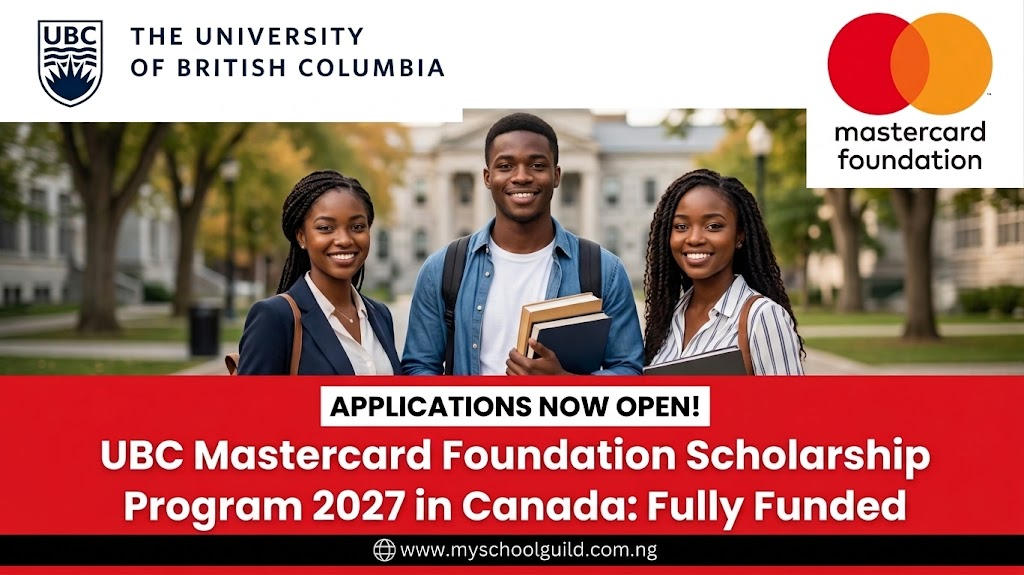
If you’re researching the Mastercard Foundation Scholarship at University of British Columbia, timing matters more than usual right now. The Winter 2027 intake has a narrow expression of interest window, and missing it means waiting an entire year for the next cycle.
This guide covers the UBC application process, who qualifies, which faculties and programs are actually funded, and what to do before the deadline closes.
What Is the Mastercard Foundation Scholarship at University of British Columbia?
The Mastercard Foundation Scholars Program at the University of British Columbia funds master’s degree study for academically strong young people from Africa, including refugees, who’ve shown leadership and a commitment to their communities. UBC has run this partnership for years now, and the current phase is aiming to support 351 scholars from across the continent.
The scholarship isn’t a partial award. It covers full tuition, accommodation, a living stipend, travel costs, study expenses, and a laptop for the duration of the program. In exchange, the expectation is straightforward. Scholars go home after graduating and put what they’ve learned to work in their own communities and countries.
The UBC Application Process, Step by Step
UBC runs this differently than most scholarship programs. You don’t apply directly to the scholarship on day one. There’s a filtering step first, and it moves fast.
Step 1: Submit an expression of interest. For the Winter 2027 intake, this is due by 6 September 2026. This is the entry point, not a formality. Leave it out and you’re not considered at all.
Step 2: Wait to hear if you’re invited. Eligible candidates who cleared the expression of interest stage are invited to submit a full Mastercard Foundation Scholars Program application between 15 and 30 September 2026.
Step 3: Complete your full application. This includes personal statements, a CV or résumé, transcripts, and two reference letters on official letterhead. Answer each personal statement question directly. Reviewers are working through a high volume of applications, and padded answers don’t help you.
Step 4: Apply to your UBC faculty. If your Mastercard Foundation application is approved, you’ll get instructions to submit your actual UBC graduate application between 1 and 20 November 2026. Late faculty applications aren’t considered, no exceptions.
Step 5: Wait for the outcome. UBC processes faculty applications alongside the scholarship review, and final admission decisions follow standard graduate timelines from there.
Notice how compressed this is. Expression of interest to faculty application closes in about ten weeks. If you’re only starting to think about this now, you need to move quickly, not eventually.
UBC Mastercard Foundation Eligibility Requirements
Before you submit anything, confirm you actually meet the bar. Core eligibility requirements include:
- Citizenship from an African country, or refugee status connected to Africa
- Completion of a bachelor’s degree that meets UBC’s minimum academic requirements for your target program (this varies by country of study, so check UBC’s country-specific credential guide rather than assuming)
- A track record of transformative leadership and community service, not just strong grades
- A demonstrated intention to return home after graduating and contribute to your community’s development
- Financial need, since the program targets academically talented students who wouldn’t otherwise have access to this kind of education
- Age 35 or under at the time of application, meaning born in 1990 or later
One detail that trips people up: the fee waiver. If your citizenship and correspondence address fall within one of the UN’s 50 least developed countries, you likely qualify for an application fee waiver automatically. If your country isn’t on that list, you can still request a fee waiver when you submit your application package, but you have to ask for it during the process. Submit without applying the waiver and UBC won’t refund you afterward, so get this sorted before you hit submit.
The Eligible Programs, Listed
Here’s the full list of programs UBC funds under this scholarship for the current cycle. Seven programs total, split across three faculties.
Faculty of Land and Food Systems
- Master of Food and Resource Economics (MFRE): a professional master’s built around the economics of food systems, agricultural markets, and natural resource policy. Good fit if you want to work on food security or resource policy from an economics and data angle rather than a pure sciences one.
- Master of Food Science (MFS): focused on the science behind food production, safety, and processing. This suits candidates with a food science, chemistry, or nutrition background who want to work on the technical side of how food gets made and kept safe.
Faculty of Forestry
- Master of Sustainable Forest Management (MSFM): a professional degree centered on managing forests for long term ecological and economic value. Fits candidates aiming for careers in forest policy, conservation planning, or resource management roles.
- Master of International Forestry (MIF): similar territory to the MSFM but with an explicitly global lens, built for people planning to work on forestry issues across borders rather than within a single country’s system.
- Master of Urban Forestry Leadership (MUFL): narrower in scope, focused specifically on managing trees and green spaces within cities. If your interest is urban planning, municipal green infrastructure, or city-level environmental management, this is the more targeted option.
- Master of Geomatics for Environmental Management (MGEM): built around spatial data, mapping, and geographic information systems applied to environmental problems. Fits candidates with a GIS, surveying, or environmental data background who want to work with mapping tools professionally.
- Master of Science / Master of Applied Science in Forestry (thesis based): the research-track option in this faculty. Choose this if you want to do original research and are considering a PhD or academic career afterward, rather than a purely professional degree.
Faculty of Science
- Master of Data Science: a technical, applied program covering statistics, machine learning, and large scale data analysis. Fits candidates with a strong quantitative background who want to apply data science methods across sectors, not just within environmental or food related fields.
That’s the complete list for this cycle. Notice there’s no general “environmental science” or “sustainability studies” catch-all degree here. Every eligible program sits inside a specific professional or technical track, so match your background and career direction to one of these seven rather than assuming a related program will also qualify.
You may also like:
Mastercard Foundation Scholarship at University of Edinburgh 2027/28: Full Application Guide
Faculty of Forestry vs Faculty of Land and Food Systems: Which Fits You
If you’re torn between two of UBC’s eligible faculties, here’s a practical way to think about it.
Forestry programs at UBC lean toward natural resource management, conservation science, and sustainable land use at a landscape scale. If your interest is in managing forests, protecting ecosystems, or working on resource policy that affects entire regions, this is the stronger fit. Expect coursework and research that pulls you toward fieldwork, ecological systems thinking, and policy questions tied to land management.
Land and Food Systems leans closer to agriculture, food security, and the systems that get food from production to people. If you’re more interested in how communities feed themselves sustainably, in agricultural science, or in the practical side of food supply chains, this faculty tracks closer to that work.
The Master of Data Science in the Faculty of Science sits apart from both. It’s the option to pick if your strength is quantitative and technical rather than agricultural or ecological, and if you want a credential that applies broadly across industries rather than one tied specifically to land, forests, or food systems.
Neither is a stronger scholarship pick in general. It comes down to which set of problems you actually want to spend two years working on. Pick based on where your prior academic work and career goals point, not on which faculty sounds like it has better odds, since selection weighs fit and merit within your chosen field either way.
What to Prepare Before You Submit Your Expression of Interest
Don’t wait until the night before the deadline to start pulling documents together. Have these ready in advance.
Confirm your program choice against UBC’s current eligible programs list, not a cached version from last year. Check your academic credentials against UBC’s country-specific minimum requirements, since these vary depending on where you completed your bachelor’s degree. Line up two people who can write strong reference letters on official letterhead well before you need them, since good recommenders are often slow to respond on short notice. And draft your personal statement responses ahead of the full application window, so you’re refining language during the 15 to 30 September period instead of writing from scratch under time pressure.
Common Questions
Is there an application fee? Yes, but you may be exempt. If your citizenship and correspondence address are in one of the UN’s 50 least developed countries, you likely qualify for an automatic fee waiver. Otherwise, you can request one during your application, but you must do it at the time of submission.
Can I apply for a program outside these seven? No. The scholarship only covers the Master of Food and Resource Economics, Master of Food Science, Master of Sustainable Forest Management, Master of International Forestry, Master of Urban Forestry Leadership, Master of Geomatics for Environmental Management, the thesis based Master of Science/Applied Science in Forestry, and the Master of Data Science. Applying with a different program in mind wastes your expression of interest slot.
What happens if I miss the expression of interest deadline? You’ll need to wait for the next intake cycle. UBC doesn’t accept late expressions of interest, and there’s no side door into the full application without clearing this first step.
Do I need to already have a UBC admission offer before applying for the scholarship? No. The scholarship application and the UBC faculty application are sequenced together. You apply to the scholarship first, and if approved, you’re guided through the faculty application afterward.
Does this program accept refugees? Yes. Refugees connected to Africa are explicitly included in the program’s eligibility criteria, not just citizens and residents of African countries.
Where to Register and Learn More
Go directly to UBC’s own pages for the current program list, deadlines, and application portal rather than relying on secondhand summaries, since details can shift between cycles.
- UBC Mastercard Foundation Scholars Program official page
- Expression of interest, general stream
- Expression of interest, refugee and displaced persons stream
Check this page again closer to each deadline, since UBC updates eligible programs and dates as the cycle progresses.
Conclusion
The UBC process rewards people who move early. A ten week runway from expression of interest to faculty application doesn’t leave room for last minute scrambling, especially once you factor in reference letters and transcript requests that take time to process. If you’re eligible and one of Forestry, Land and Food Systems, or Science actually fits your background, get your expression of interest in before the window closes rather than waiting to see how competitive it looks first.
Everything after that step, your personal statement, your reference letters, your faculty application, matters more once you’ve actually secured a spot in the pool being considered.

 Damilola Mariam
 Francis